Kidults Fuel Hong Kong's Toy Resale Boom: Nostalgia, Emotion, and Investment Drive Adult Collectors
Reported by: Anson, Luk Chun-hei
Supervised by: Ms. Robin Ewing
Adults fuel the Toy Collecting Market
Hong Kong may not manufacture toys, but its second-hand toy market is very active. Many adults collect toys from their childhood, not just for memories and comfort, but also as investments. These toys are often kept in small homes or storage units, and their prices can become much higher than before.

Yim Chun-tung, 38, works renting out cameras and filming equipment during the day. At night, he spends time in a rented storage space where he collects and organizes his toys.
He says his hobby of collecting started when he bought a Metal Build Evangelion Unit 2 during the pandemic, when he was bored and noticed it in a shop display.
“I saw that Metal Build and thought it was very beautiful,” he said. “I was already a fan of Neon Genesis Evangelion, so I bought one just to try it… and then I saw the mecha look, I twisted it a bit, felt its weight, and immediately became obsessed with the quality.”

Evangelion Unit-02 (Metal Build) — prices usually fall between HK$1,150 and HK$2,800.
 |  |  |
|---|---|---|
 |  |  |
 |
Yim’s whole room of toy collection is estimated to have already exceeded six figures in Hong Kong dollars, reflecting both its scale and growing value.
Starting with just one Evangelion figure, his collection quickly grew into large glass cabinets filled with Hot Toys, blind boxes, and Transformers. He didn’t just buy them to show off, but also to make up for a childhood when he couldn’t keep his toys for long.

When Tung was still a kid, he was constantly rewarded with toys for good grades, only to see his parents throw them away during spring-cleaning.
“Now, as an full-growth adult. I saw my old toys and realised I had owned them before, but I didn't preserve and keep them well,” he said.
One particularly painful loss was the Yūsha Densetsu (Brave Saga) Wyvern-like combining vehicle, which his mother made him throw out himself.
“I threw it away with my own hands,” he added. “Now there is a new version of it, but I still haven’t received it. It feels like I’m getting that memory back, but I haven’t actually held it yet.”
Tung now buys toys for two reasons: for his feelings and as an investment. He often buys two of the same toy—one to keep sealed, and one to sell later if needed—because once a box is opened, no one can’t guarantee its value.
He is careful about the rampant speculation on platforms like Carousell, where childhood toys such as Soul of Chogokin are sometimes sold for up to four times their original price.
“I don’t like toy speculation,” he said. “But if the price goes up, it means people think it has value. Still, I wouldn’t recommend purely speculating on toys.”

Tung recently kept sealed the Hot Toys MMA752AE 1/6 figure—TDKTJ(BI) (AE), a Joker-version Batman figure. This is a super limited global edition, priced around HK$3,250–HK$4,180.


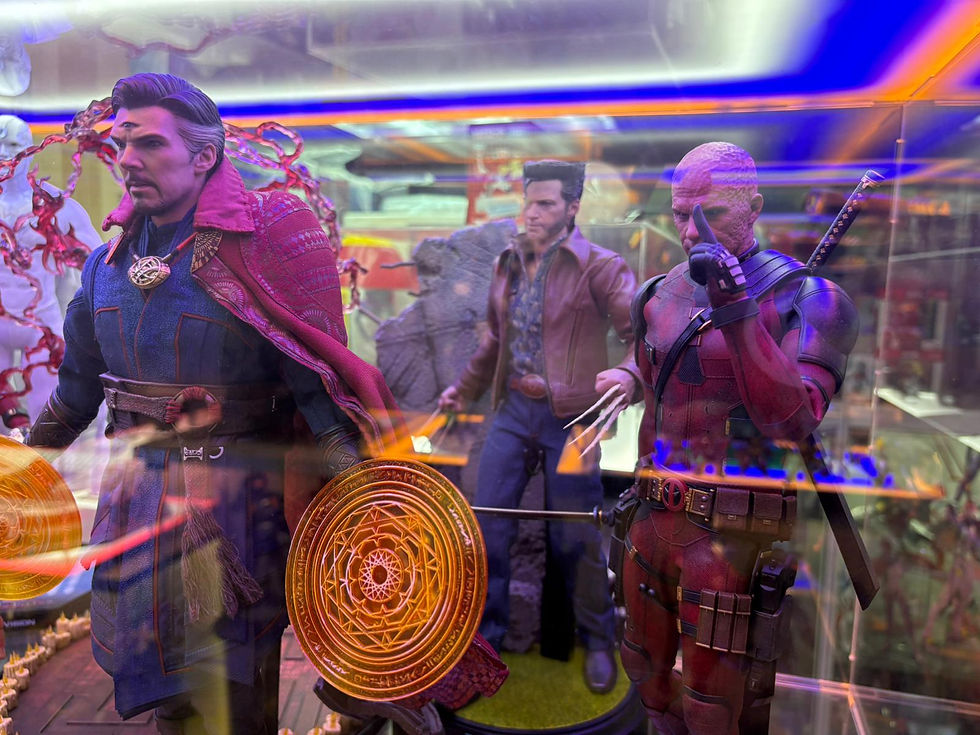


Yim’s collection is not cheap: at his peak during the pandemic he spent half to seven‑tenths of his salary on toys, whereas now it has dropped to one or two tenths. He thinks the emotional payoff is what justifies the cost.

“I enjoy the moment I buy a toy, carry it home, and open the box,” he said. “That moment is my happiest moment. It’s a way to relieve stress, like how others might drink.”
Tung shared how his circle of like-minded friends—all bonded by a shared toy-collecting obsession as adults—embrace it fully as adults.


“As an adult, we all have the ability to own them now—no more worries holding us back,” Tung said. “We love this feeling of freedom and the thrill of possessing everything we desire. That's what being an adult truly means.”
Tung's mindset is what pushes the high-end toy industry to keep creating new and better products.


Premium toy brands like Hot Toys, ThreeZero, and Metal Builds command steep prices because collectors demand and willingly pay for uncompromising quality.
With no limits on quality, these companies focus on fans who see collecting as a kind of luxury escape. They spend more money to make toys with better details, materials, and larger size. Tung believes this is why adult collectors are the main driving force behind these toys.

Yet as he moves toward the next stage of his life, he is buying less. He need to save money for marriage and other adult responsibilities, and says he realizes he can no longer sustain his earlier spending habits.
“I need to prepare for the future,” he said. “I still enjoy that moment of coming home with a toy, but I can’t keep expanding my collection like before.”
Tung’s Hot Toys 1/6 collection has grown to 30+ pieces, with items priced between HK$1,500 and HK$3,500+.


For Yim, toy collecting is no longer about endlessly buying more things, but something he needs to balance with money and emotions as he need to enter the next stage of his life.
While many adults who grew up in the 1990s are rediscovering and collecting toys now that they have greater financial means, Generation Z, those born in the 2000s and now young adults is also developing similar collecting habits, shaped by different childhood experiences and motivations.
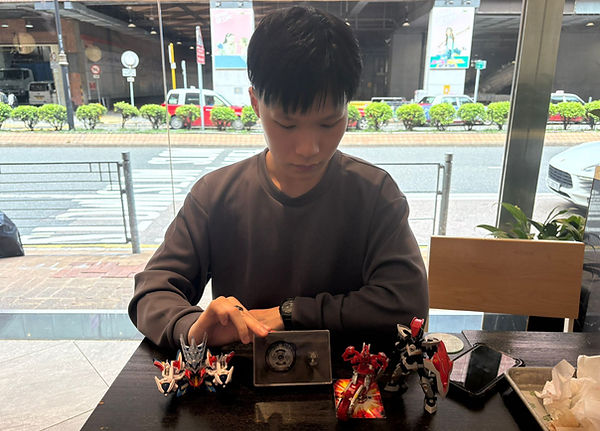
Kirby Wong, 20, a part-time worker and student, speaks with a mix of nostalgia and unease when he talks about his collection.
His core obsession is spinning tops, especially the older Metal Fight Beyblade (MFB) and the later series, Beyblade Burst.


“The MFB I own now is the same model I used to watch from kindergarten through primary school,” he said. “Back then, my family wouldn’t buy it, and I was too young to compete for it anyway. Now I can make my own choices. Even though it’s expensive, it’s a limited edition—and I’m willing to spend the money, even if it doesn’t make sense, just to finally have it.”
The toy Wong owns is the rare Phantom Orion B:D Black Skeleton Version Beyblade, a limited-edition WBBA (World Beyblade Association) release from the Beyblade Metal Fight (Metal Fury/4D) saga.
With only around 100 units produced, it's a highly sought-after collector's item among enthusiasts.
Market listings show prices ranging from approximately HK$3,000 to HK$4,100, and Wong purchased his for HK$3,200.


He keeps around 20 to 30 Beyblade spinning tops, some for active play, others strictly for display. Like Yim, he speaks of childhood breakage and loss. Wong once had a prized called Dual Star King Beyblade; when his grades dropped, his parents threw it away.

That feeling of loss still affects him when he looks at online marketplaces. The Beyblade he once loved was thrown away by his parents when his grades got worse. “It cost HK$400 to HK$500; now Carousell and Facebook groups list it for sky-high prices.”
He has seen how nostalgia can distort value. On Carousell, he realised that a local Burst Beyblade top he picked up for 100 Hong Kong dollars was far below market price, and went on to resell it for around HK$800.
“In Carousell you can see people listing things for much more than their real value,” he added. “Some listings are more for showing off than for selling.”
Yet he still sees the logic in paying extra for memory.
“I’ll buy expensive toys if I really want them,” he said. “If I can afford it, I think it’s fine. Some memories are priceless.”

Wong also chases rare, out-of-production toys like Bakugan battling orbs and Bandai's Little Battler eXperience (LBX) micro-robots, fueled by childhood longing.

LBX Achilles Deed from the series Danball Senki (Little Battlers Experience), manufactured by Bandai, original price is HK$70, but now it is priceless.
During COVID lockdowns around 2020, Wong shifted from gaming to collecting toys. Gaming cost thousands, but he felt it was virtual; he wanted to own actual items that could be physically held or touched.
“Small toys I couldn't buy as a kid, now I buy them back, snapping up Japan-exclusive Bakugan and LBX reissues on Carousell, where original HK$30 to 50 sets now hit hundreds.”

Bakugan Mobile Assault vehicle known as Zoompha (specifically the Pyrus or red version), which is shown carrying a Titanium Dragonoid figure, priced around HK$318 and now is also priceless.

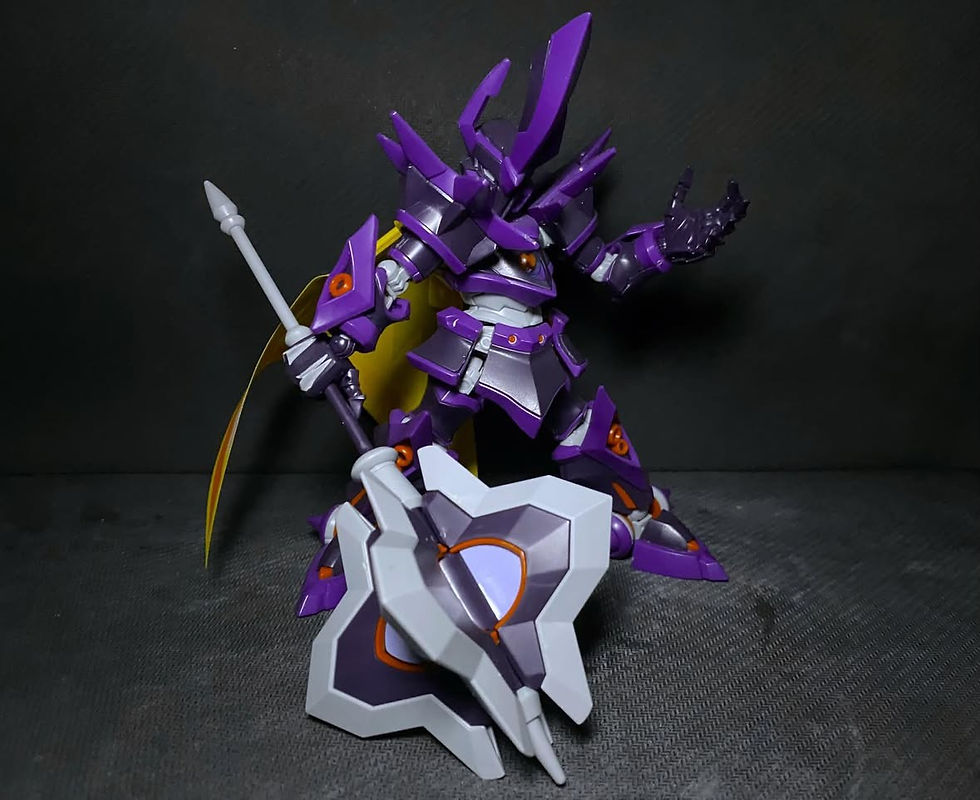
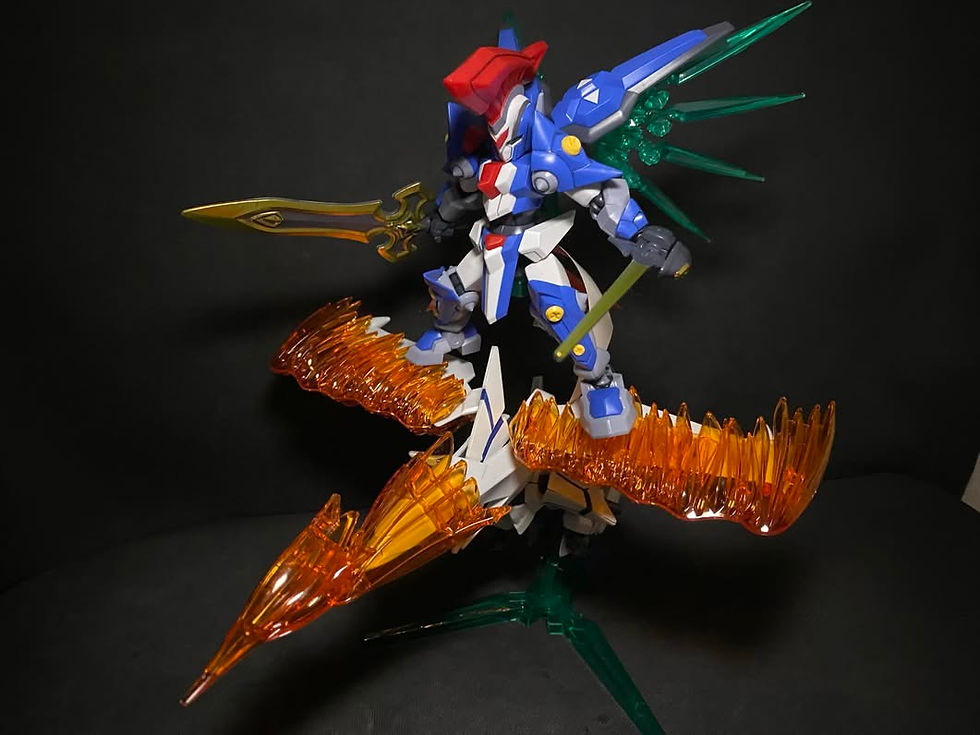


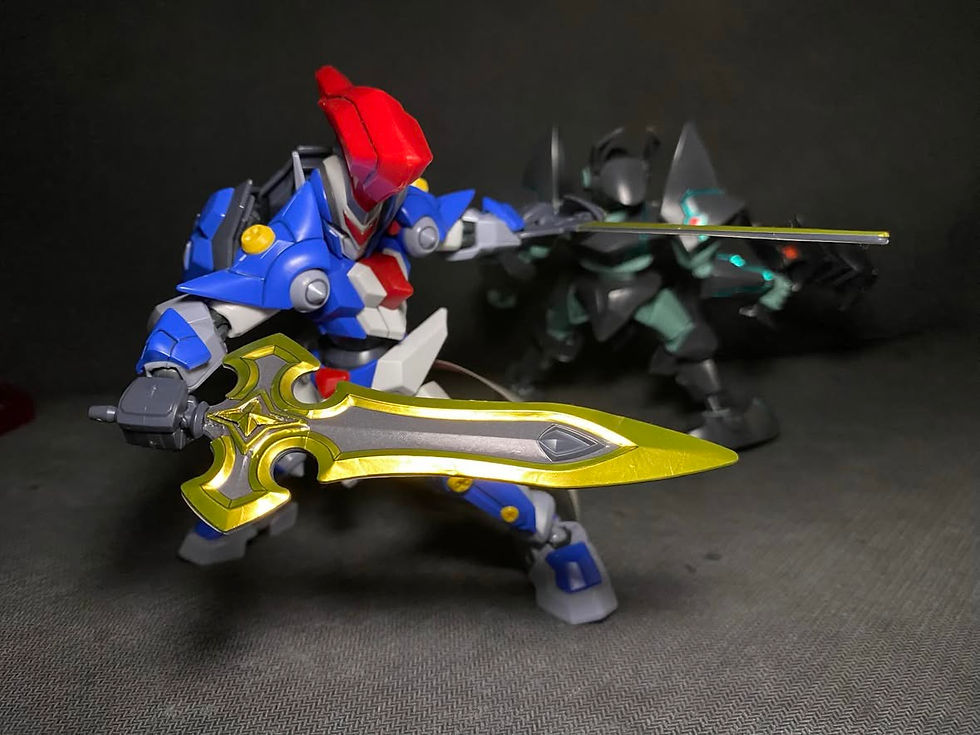


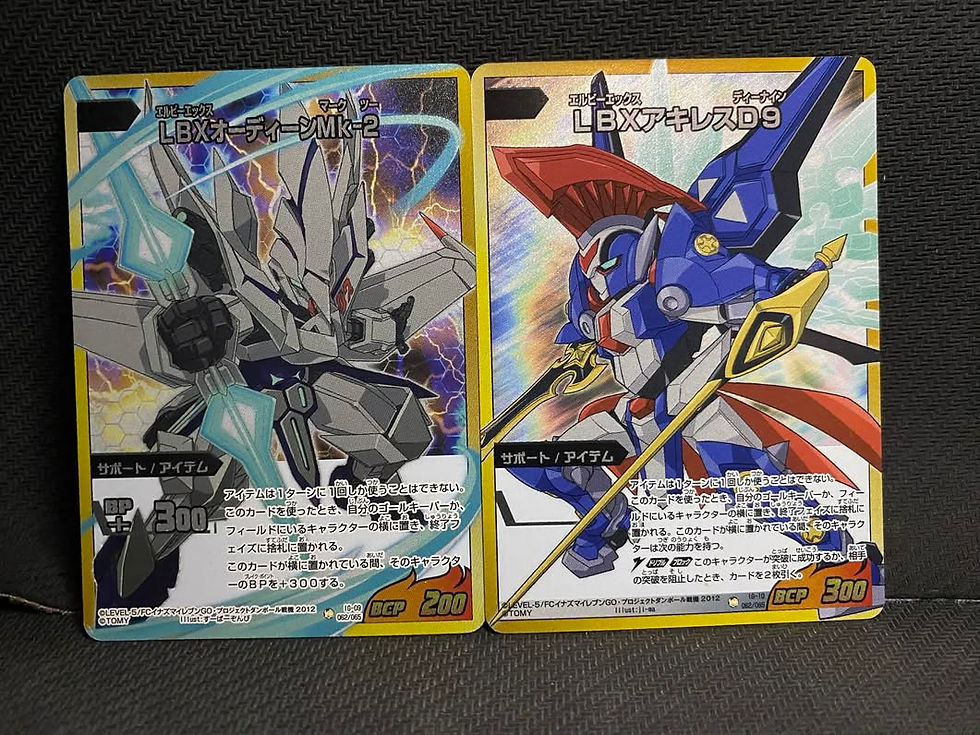


Bandai halted regular LBX model kit production after the anime and game support ended in the mid-2010s, shifting focus to lines like Gunpla amid supply chain challenges. Limited P-Bandai reprints of early series kits occurred up to 2024, but popular models like Hyper Function Ifrit never returned.
Common kits like Achilles or Emperor sell for HK$60 to HK$90 at Hong Kong shops for remaining stock or reprints, while rare out-of-production models fetch HK$300 to over HK$1,000 on secondary markets.
Wong could resell them in the future—they all have market demand in Hong Kong—but at this moment he just enjoy owning them, and it is a good toy investment.


Emotionally, his collection is more fragile. He has already started planning an exit strategy.
After his father passed away recently, leaving behind a large collection of priceless sneakers, which he watched his mother struggle with what to do with them.
From this heartbreaking experience, he came to understand the fragility of life and that the belongings he leaves behind after death could become a burden to those he loves.
“I don’t want my family to be left with something they don’t know how to handle,” he said. “I’m thinking about selling, so I won’t trouble them later.”
“When I get back from work and look at the cabinet, just seeing them makes me happy,” he said. “It’s like a private romance with my own things,” Wong added.
 IMG_0340 |
|---|
 IMG_0338 |
 IMG_0336 |
 IMG_9551 |
 IMG_9614 |
 IMG_9613 |
 WhatsApp Image 2026-03-07 at 02.58.20 (1) |
 IMG_9611 |
 IMG_9608 |
 IMG_9601 |
 IMG_9595 |
 IMG_9589 |
 IMG_9585 |
 IMG_9572 |
 IMG_9571 |
 IMG_9570 |
 IMG_9578 |
 IMG_9562 |
 IMG_9558 |
 IMG_9559 |
 IMG_0214 |
For now, though, the joy remains in the hunt and the display.
For Wong, collecting is not something he will do forever, but something that brings him happiness for now.
If one day he decides to sell everything, it will be out of a sense of responsibility—ensuring that his toys are passed on to people who will continue to truly appreciate and care for them.

For both Yim and Kirby, toys are no longer just for play, but are connected to family, memories, and thoughts about life and death. Both of them are starting to set limits: Yim is buying less and trying to balance work, money, and life (including marriage), while Kirby is thinking about selling his toys so his mother won’t feel confused or sad like she does with his late father’s belongings.
In Hong Kong's second-hand toy market, where nostalgic items regularly sell far above their original price, the emotional logic is simple: sometimes people pay more because they are not just buying a toy, but a piece of a past they can never truly get back.
Local Toy Designer uses Nostalgia and Passion

Jimmy Ho Man-kit, 47, is a Hong Kong toy designer and seller who has turned a lifelong love of vintage toys into a brand-building effort rooted in nostalgia, local identity, and the realities of Hong Kong's shrinking creative space. (Founded Space Mars)
Speaking about his work and the toy industry, he said the pandemic pushed him from collecting into making, and that the rise of Labubu which created by Hong Kong designer, Kasing Lung, shows how powerful promotion can be in turning a character into a global phenomenon.
According to the Pop Mart 2025 Annual Report their Monsters series, including Labubu, generated HK$160.8 billion in revenue for 2025, up 3.66 times year-over-year. Plush toy sales reached HK$211.5 billion, half of total revenue. First-half 2025 plush sales hit HK$6.76 billion.
Official blind boxes sell for HK$159 to HK$466 on Pop Mart's Hong Kong site. Resale prices range HK$300 to HK$360 at In's Point shops in Yau Ma Tei, while high-end deals reach insane prices.


An example for the market's history, a 131cm mint-green first-generation Labubu sold for 1.08 million yuan (approximately HK$1.15 million) at Yongle International Auction House in Beijing.
From Ho's perspective, Labubu's remarkable success is not only driven by its distinctive creative design, but also significantly amplified by celebrity influence, including support, promote and praise from global superstars such as Lisa of Blackpink.
Ho said he was never simply a collector in the formal sense, but someone who has always loved toys.
He has been collecting for about 20 years, with a focus on toys from the 1970s and 1980s.
Over time, his personal interest became the foundation for his business, as he began designing and producing toys during the pandemic when work and daily life had slowed down.
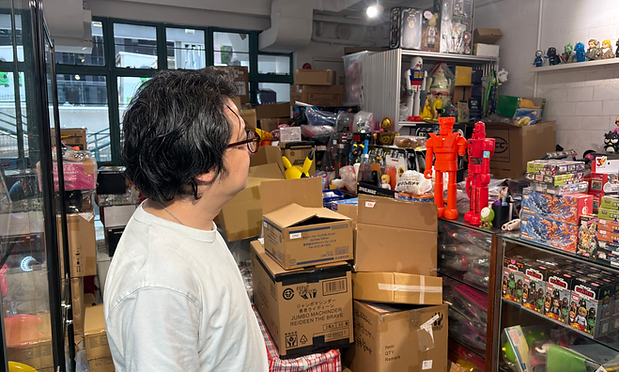
“I was thinking that since I couldn’t go out and had nothing else to do, why not try making toys and pursue my dream,” he said.

When Ho has a toy design idea, he often turns to Generative AI right away. It helps bring his concepts to life as visual references—his first step in the brainstorming process for toy production.
“As a toy collector, I’ve realized that not every design I imagine exists on the market. Sometimes I come up with ideas for unique designs that I wish I could own, and that inspires me to create and produce them myself,” Ho added.
He explained that he started by drawing designs and then finding help to turn them into 3D models.
During COVID, he could not travel to mainland China easily, so the process took extra effort and required him to manage things through different channels.
He described the early stage as a period of trial and error, saying that there were many failures and successes, but more failures than successes. The point, he said, was simply to try because he did not yet know what the right sales channel would be.

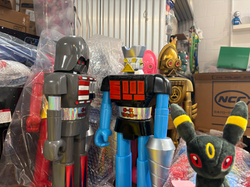
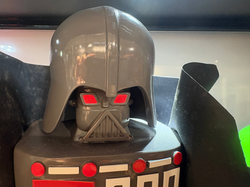
3D printed Jimmy Ho’s Mazinger Z toy concept in a nostalgic ’80s plastic vintage design
 |  |  |
|---|---|---|
 |  |  |
 |  |  |
 |
“Modern toys have lost the local flavour that once made Hong Kong special,” Ho said.
He designs his toys with a sense of nostalgia, trying to bring back the old style of Hong Kong toy-making. He looks to the past, when local makers took ideas from things like Star Wars and Japanese robots and turned them into something unique to Hong Kong.
The size of these toys made them less market-friendly, especially for Hong Kong consumers, who—with limited living space—are reluctant to dedicate valuable room to oversized collectibles.
Even if they are interested in the designs, concerns about space often discourage them from making a purchase.

Space Mars first focused on making large robot figures, but they soon ran into practical problems.
This approach gives his work a retro, space-style look.
Ho wanted the toys he creates to feel old in a good way, but still fresh today. Therefore, his brand name, Space Mars, reflects that vision—mysterious, cosmic, and rooted in curiosity.


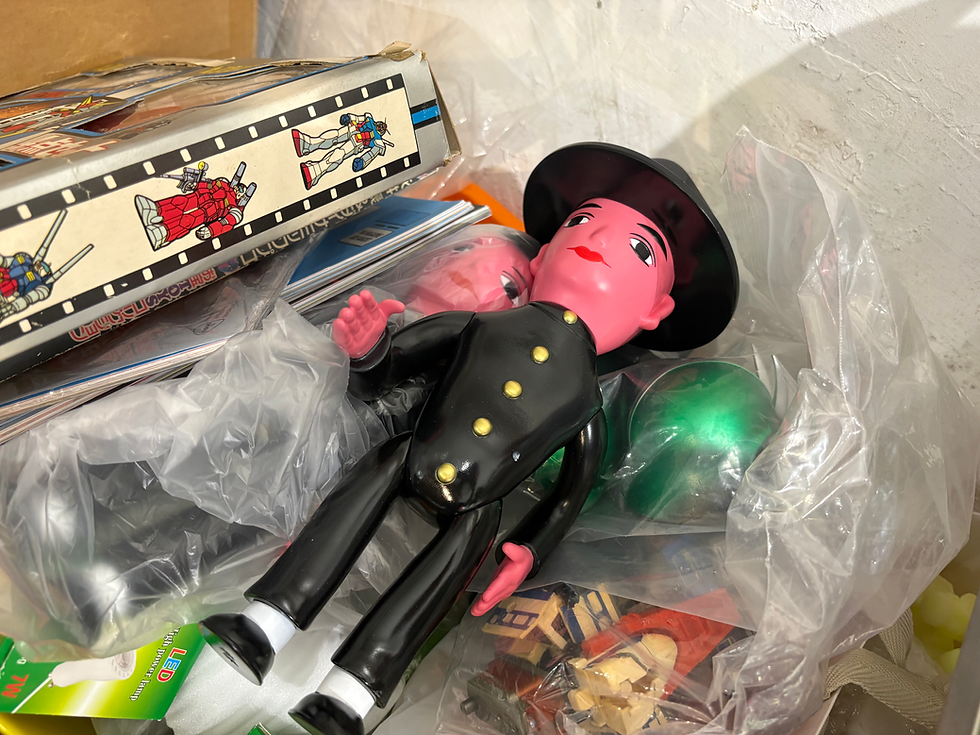
Still, he wanted something more rooted in Hong Kong, this resulted in his paper-dolls series under Creepy Sofubi.
“I didn't want pandas or obvious symbols,” Ho added. “I wanted something unusual but still representing Hong Kong, so I combined the concept of paper dolls from paper-craft shops with plastic figures. A unique toy idea no one produce in the toy industry.”
 |
|---|
 |
 |
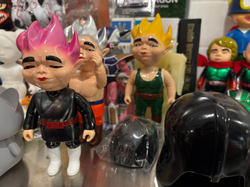 |
Then he changed to making smaller figures, but trends changed again. Star Wars became too common and was no longer exciting for younger buyers. So he created Super A Design, a series of cuter characters that became popular in Taiwan.
Drawing from the slang “play evil dolls” in chinese, he described it as an evil toy—not dark, but culturally striking and distinctive.
Under Hong Kong's economic decline, it has affected every sector of business, including local toy production.
Facing young people's trend toward electronic devices which offer more entertainment options than physical toys. Ho believes toys haven't disappeared; they've just changed form.


“Toy won’t disappear,” he said, pointing to how electronic devices and trends like Pokémon cards have reshaped how younger generations play and discover toys.
He added that in the future, family influence matters a lot: “When parents like something, they bring their children into it.”
He rejected the idea that physical toys and toy production are fading.
But in modern times, in the world of toy production, trend cycles are the key of being success.
“Pokémon remains popular because it keeps introducing new characters, while older robot series have lost their appeal over time.” Ho said. “As a result, original toy design is much harder to sustain,” and many in the industry fall back on established brands.”


“A new design can cost anywhere from HK$30,000 to HK$70,000,” he added.
Production also carries significant financial risk. At the same time, consumer preferences are shifting toward affordability, with many buyers seeking products that are both inexpensive and visually appealing.
“The current trend is fast and cheap, people want something that looks good without costing too much.” he said.
That reality continues to shape his decisions. He explained that although he comes up with new ideas every day, he cannot bring all of them to life. Many are set aside due to high costs or uncertain market demand, the ongoing challenge of balancing creativity with financial sustainability.
Ho offers straightforward advice to young creatives, encouraging them to take action rather than hesitate. He emphasizes that whether one supports the toy industry through collecting or by creating their own products, both reflect passion for toys.
In his view, overthinking often holds people back, while taking action is what truly leads to progress.

At the same time, he stressed the realities of the industry.
“If you’re in it just for money, you won’t last,” he said. “Building a local toy brand in Hong Kong is too hard, and there are too many setbacks.”
What matters most, in his view, is simple: You need real passion to keep going.
Emotion drives Adults Collect Toys
Sunny Mok Hei-yeung, a 26-year-old freelancer living in Ho Man Tin, fills his small room with more than 100 Gundam models he has loved since childhood.
Mok represents one of the fastest-growing forces in the global toy market: adult collectors, who collectively spend more than US$10 billion annually worldwide on collectibles—from model kits to transformation belts and figures.
Some people, like him, buy toys to reconnect with childhood memories and find comfort in Hong Kong’s stressful life. Others see toys as investments, buying and reselling limited editions in places like Mong Kok, Sino Centre, and online platforms, making Hong Kong a major hub for toy trading in Asia.

Mok watches his favorite episode where Wing Gundam first appears, and even as an adult, this episode keeps playing in his mind, a comforting memory that never fades.

In the late 2000s, Television Broadcasts (TVB)’s After School ICU programme showed reruns of Mobile Suit Gundam Wing. The main character, Heero, pilots the Wing Gundam in battles with explosions, bright lights, and intense space fights. When Mok was a child, he was completely attracted by the anime.

The white, blue, and red robot is the first edition of Gundam Wing from the original TV series that Mok first watched and loved.
Mok explained that the Mobile Suit Gundam Wing follows Heero Yuy, a skilled young pilot who battles against an oppressive regime in a future where war is common.
“With his powerful Wing Gundam, Heero fights for freedom and peace, navigating complex relationships and his own inner struggles along the way,” Mok added. “That space war, that lone drive—it bit deep into my childhood memory.”
“I don't know why—maybe I really like robotics anime?—but it held me tight and has shaped my interests and habits to this day as a grown adult,” he said.

As a child, Mok didn't know big words like war, hate, or freedom. But he grasped one thing: Lacus Clyne (the 16-year-old female lead) fights for her friends, facing loss yet staying strong.
“These mirrored my life back then,” Mok said. “In Hong Kong, kids grow up too fast, and I felt left behind, struggling in school and lacking confidence. But seeing the pilots take on incredible challenges inspired me to believe there's still room for my dreams in this world.”
Because he felt a strong emotional connection to Gundam—the comfort it gave him during difficult school years and the memories it created—Mok started buying, building, and collecting Gundam models to relive that childhood happiness.
Hong Kong's Gundam fans are enjoying great success thanks to Bandai Namco Holdings' huge profits. The franchise's rapid growth is showing the strong local demand for model kits and collectibles.
Since 1979, Gundam has sold over 500 million Gunpla kits worldwide, with Hong Kong emerging as a key Asian market via hobby districts like In's Point. According to Bandai, their targets toys and hobby products across children, collectors, and adults, with core gamers often 18-35 years old (predominantly male).
The priciest collectibles command premiums: Bandai's HY2M Hyper Hybrid Model RX-78-2 Gundam, originally ¥350,000 (about HK$18,000), resold for US$10,000 (HK$78,000) to US$34,500 (HK$269,100) on eBay—the global online marketplace, among the most expensive Gunpla ever auctioned.

Mok's gundam—a MG Wing Gundam, or Mobile Suit Gundam Wing, premiered on April 7, 1995. The main character is Heero Yuy, and the model kit is about 18 cm (7 inches) tall.

Animes-Pro in Hong Kong is a popular reseller specializing in anime merchandise, with Gundam model kits (Gunpla) as their main product — these kits are the most popular and receive the largest discounts compared with most other major resellers.
Animes-Pro is a Hong Kong-based retail and wholesale company specializing in toys, collectibles, figures, dolls, and Japanese anime merchandise.
Established in 1997, it operates multiple branches across the city, with its flagship store in Sham Shui Po—a hub for such products popular among locals and tourists.
“Animes-Pro's top seller has to be Bandai's Gundam model kits—they're beloved by both teens and adults,” an Animes-Pro staff member said. “With the recent hit series Gundam GQuuuuuuX driving demand, we frequently run surprise discounts—sometimes up to half price or more.”

A Cheung Sha Wan Animes‑Pro staff member updating price tags after restocking.

Animes‑Pro’s toy shelf showcasing the hottest sellers: the latest Bandai Gundam model kits from Gundam GQuuuuuux.
“Students and after-work shoppers often can't resist picking up a box or two when they see such unbeatable prices,” the staff member added.
At Animes-Pro, the High Grade (HG) 1/144 GQuuuuuuX (Endymion Unit Awakened) now sells for HK$48 (originally HK$148)—a HK$100 savings, or 67.6% off. It's an incredibly affordable find for a Gundam model kit: high value at a bargain price.
Official company reports confirm Bandai Namco's record revenues, fueled by the December 2025 opening of The Gundam Base Hong Kong—Asia's first official flagship store.
Located at The Twins Tower II in Kai Tak, Kowloon, the 4,500 sq ft venue features over 100 Gunpla models, interactive exhibits, and a towering God Gundam statue, drawing massive crowds amid Hong Kong's vibrant pop culture scene.


Bandai report targets expansion amid Asia's 9.6% revenue share (ex-Japan) in H1 FY2025, with plans for fivefold growth in Cross Stores by 2030 including Hong Kong.
Bandai Namco Holdings announced the Gundam IP generated ¥153.5 billion (about HK$8.2 billion) for fiscal year 2025 ending March 31—up 5.35% from ¥145.7 billion the previous year and nearly double the ¥79.3 billion of 2019.
Mok's first model came during his second year of secondary school: he saved months of pocket money for an HG Strike Gundam, bought from an old shop in Ho Man Tin.

The model kit in the middle with the large blue wings is Mok’s MGEX 1/100 Strike Freedom Gundam from Mobile Suit Gundam SEED HD Remaster. It was purchased from Premium Bandai and cost HK$950.

Mok discovered the latest 1/60 PG (Perfect Grade) NU Gundam for HK$4200 at a traditional model kit shop. Now he must decide whether to buy it right away or wait for the price to drop.
He remembered how the smell of glue and model oil felt like home. In the past, model shop owners would build their own kits while working, displaying finished models to attract kids.


Late in secondary school, his Ho Man Tin room filled box by box. Shelves held no books—just HG, MG, RG, and MGEX kits, the different grades of Gundam models.
When he building Gundam models carries little social value in Hong Kong. His friends questioned his continued involvement, calling it childish. During a visit to his room, his ex-girlfriend eyed the display cabinets and suggested selling the models for nicer decorations. Those comments stung deeply, causing real emotional discomfort.
He once tried to hide his models and swore off building more. But he's truly in love with Gundam, savoring the moments of building and displaying them.

Mok browsed through Gundam kits that he didn’t own yet, looking for ones he could rebuild or customize in the future. He aimed to buy them at the lowest price and store them at home for future modifications.
“Building Gundam kits is like learning patience,” Mok said. “It takes skill and time. Every cut and every brushstroke helps me calm down and clear my mind. It's become a habit, part of my life. It brings me joy.”
“My years of building Gundam have been about creating and guarding my nostalgia,” Mok added. “Despite facing hate and misunderstanding, I want to avoid future regrets about not owning what I love. I lacked the money in the past, but now I have the choice.”


“After school or work, it's the packed MTR, rushing through projects, eating fast food, and chasing deadlines,” Mok said. “People in Hong Kong are always rushing just to survive, and as one of them, I feel like I have no soul left.”

Whenever Mok feels pressure, returning home to the cabinet filled with neatly arranged models brings him comfort. These quiet friends who have been with him through his journey, bring positivity and relief as he admires what he loves.
Days pass, and his collection grows: from tens, to thirties, sixties, and now nearly 100.
Rows of High Grade (HG), Perfect Grade (PG), Master Grade (MG), and Real Grade (RG) kits—sorted by series and year.
Some limited editions, some with his custom color changes and LED additions.
For Mok, each all are unique and built under his hand.
“Mok firmly believes that being an adult doesn't mean giving up on passions,” he said. “Grown-ups shouldn't dismiss what they love. Gundam teaches respect, patience, focus, creativity—and even brings peace with oneself.”

Mok is selecting the model ink for his upcoming customization project and comments, "Tamiya ink is the best; I won't buy from other brands."
 WhatsApp Image 2026-02-07 at 20.18.23 |
|---|
 WhatsApp Image 2026-02-07 at 19.57.57 |
 WhatsApp Image 2026-02-07 at 19.56.08 |
 WhatsApp Image 2026-02-07 at 19.54.45 |
 WhatsApp Image 2026-02-07 at 19.54.27 |
 WhatsApp Image 2026-02-07 at 19.58.48 |
 WhatsApp Image 2026-02-07 at 19.46.15 |
 WhatsApp Image 2026-02-07 at 19.47.57 |
 WhatsApp Image 2026-02-07 at 19.47.28 |
 WhatsApp Image 2026-02-07 at 19.52.33 |
 WhatsApp Image 2026-02-07 at 19.50.31 |
 WhatsApp Image 2026-02-07 at 19.52.43 |
Mok's collecting passion runs deep. He still hunts for old stock on weekends and scours Mong Kok for the latest models.
Bargaining feels like a life skill to him, in order to buy those model kits he did not own yet in the lowest cost.
“In the future, I'll keep building, box after box, year after year,” Mok said. “Even when I'm old, I'll tell the next generation their builds are beautiful. Keep it up—Gundam is worth preserving. Because in tough times, they save hearts and memories like mine.”

Wong Kuan-hang’s Gundam collection—55 models total—featuring primarily HG, RG, and MG series kits.
Another gundam lover Wong Kuan-hang, 24, a nursing student and fellow Gundam lover, began building models in his youth.
Wong started everything from watching Mobile Suit Gundam for the first time.
The animation's visuals caught his attention and made him want to collect Gundam models ever since. He added that he first watched the series also through TVB program, following each episode until it became a daily habit.
“My first Gundam was a 1:144 RX-78-2, the original version,” Wong said. “It was a gift from a friend when I was 18. I was happy, but still a beginner then. That marked the beginning of my Gundam collecting.”
After that, he began watching tutorial videos, buying tools, and learning painting and modification techniques.

Wong’s first ever Gundam was an HG 1:144 RX‑78‑2 Gundam, gifted to him by a friend.
“Collecting Gundam isn't just about buying toys,” Wong said. “It's a way to continue the story of the series I grew up with—my emotional connection to it.”

Official Bandai data shows Gundam as a major model-kit category. Related fan and event data reveals strong anime appeal in Hong Kong. Bandai Namco's 2025 fact book reported 810.72 million cumulative shipments of Gundam series model kits by March 2025.
Bandai's Global Gundam Poll 2025 showed Hong Kong voters ranking Nu Gundam first among Traditional Chinese participants.
GUNDAM.INFO also reported packed crowds at Gundam Docks at Hong Kong II, showing how anime popularity sustains local enthusiasm for Gundam products.
Wong's first model was the original Gundam, but his favourite remains Zaku—the opposing mobile suit.
“It stands out with one eye and red design,” Wong said. “It's simple but classic.”
In Gundam, Zakus are known for their bulky war-machine design, recognizable head shape, and mono-eye visor.

Wong's favorite Gundam models are his Zaku kits—especially the HG 1:144 MS-06S Zaku II (Red Comet Ver.).
They embody the Zeon Earthside aesthetic with armored paneling and battle-worn details, wielding weapons that match their unit style. Many famous Zakus appear in red—linked to their faction, battlefield visibility, and Char Aznable's iconic branding. Their unique design and customization options keep them popular in model-kit culture.

Wong stores his Gundam model kits in plastic boxes to protect them and because of limited space—packing them away keeps his room looking neat, tidy, and clean.
“Space is the biggest problem in Hong Kong,” Wong said. “Homes are small, and it's hard to find room to display models even when you want to.”
Each model for Wong carries meaning.
“Some are gifts, some I bought while travelling, others from my own savings,” he said. “They all hold memories.”


Sharing his work online helped him connect with others who share the same passion—discussing skills, exchanging advice, and joining exhibitions together.
In the future, he hopes to open a studio with friends to own a space, share building and painting techniques while selling Gundam models, turning his hobby into something meaningful and potentially profitable.
Despite comments that buying models is childish, Wong said he has no concerns.
“When I was young, I liked them but couldn't afford them,” Wong said. “Now I can. As long as I manage my expenses, there's no problem spending on hobbies.”
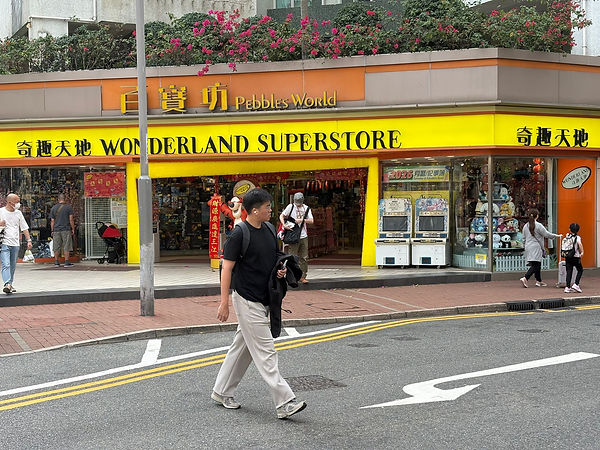
Wonderland Superstore (奇趣天地) is a well-established chain of lifestyle and hobby stores in Hong Kong, specializing in toys, stationery, and collectibles. Since its first store opened in 1999, it has grown into a popular destination for toy retailer.
In Hong Kong, these Bandai franchises are far from niche: Kamen Rider DX belts and S.H.Figuarts fill shelves at major chains like Toys"R"Us and big-box retailers such as Wonderland Superstore, featuring large, well-curated displays of action figures and model kits.

Popular shopping venues like Sino Centre and In's Point remain go-to spots for toy reselling and collector shopping in the city.
Wong Hei-chun, a 21-year-old freelance photographer, has been collecting Kamen Rider transformation belts since primary school.
He loves visiting places like Sino Centre and In's Point to hunt for treasures, especially out-of-production Kamen Rider items.
When Wong was six, Saturday mornings meant one thing: Kamen Rider.
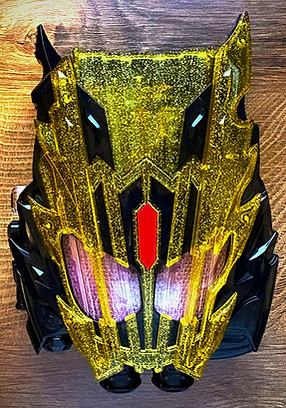
Now 21, Wong owns more than 20 Kamen Rider transformation belts—the devices used by the characters to henshin, or transform, on screen.
The belts, each about 24 centimeters long—roughly the size of a Nintendo Switch—are too large to display all at once. Only a handful sit on his shelf; the rest are packed in boxes under his bed.

Wong shows off his recent favourite Kamen Rider card—featuring Kamen Rider Ryuki—while watching the 2002
Sitting in front of the TV, he watched masked heroes transform with flashing belts, turning into insect-themed fighters who battled villains on motorcycles.
The 25-minute Kamen Rider episode became the most exciting of his week.

Both are Kamen Rider Decade Henshin Belts, a card-based reading system called the Decadriver. On the left, the pink belt is the 20th Anniversary Edition; on the right is the original 2009 version, each cost approximately HK$500.
“At first, having the first few belts felt like fulfilling a dream,” Wong said. “But after a while, the excitement fades. You become numb — it turns into this urge to collect them all.”
Wong, now a freelance photographer, first encountered the franchise through local television broadcasts. Among the many series, Kamen Rider Decade left the deepest impression.
The character's ability to transform into past Riders made it especially compelling for a young viewer just discovering the franchise.

Now financially independent, Wong has slowly built his own collection, with over 20+ kamen rider henshin belts.
“As a child, owning the toys was out of reach. Back then, I had no money,” he said. “'I'd just watch others play or borrow theirs for a while. His first belt came as a prize from a school fair.”
Years later, with his own income, he began building his collection piece by piece.
Some items, especially limited editions, now cost significantly more on the resale market.
One of his favorites—a black-and-gold Ohma Zi-O driver—has more than doubled in price since its original release.

Wong shows his recent photography job and explaining that the results are totally different from what he wanted to film—the style isn't even close to Tokusatsu.
Despite the cost, Wong does not see his collection as simple consumerism. The series continues to shape his creative work.

Wong's DX Ohma Zi-O Driver is a premium, champagne-gold transformation belt featuring red accents special design, originally released as a Premium Bandai exclusive for approximately HK$600 (now retailing for HK$1,000+ on the secondary market)
“I work in media, mostly photography,” he said. “I shoot different themes like romance, lifestyle, etc. But I want to try filming something like Kamen Rider, something tokusatsu style. The childhood memories and the action design inspired me. I want to see if I can do something similar myself one day.”

Wong's favourite Kamen Rider Decade (2009) is the 10th anniversary series of the Heisei era. Its protagonist, Tsukasa Kadoya, is a dimension-hopping photographer known as the "Destroyer of Worlds."
His fascination with the special effects, fight choreography, and design has also shaped his career goals.
Kamen Rider, known in Japan as Masked Rider, is one of the longest-running tokusatsu (live-action special effects) franchises.
Known for its fight scenes—which combine martial arts moves with special effects and finishers like the Rider Kick—shows such as Kamen Rider Decade are often highlighted for their clear, fast-paced action, where each new form and weapon changes the combat style.
Even with simple CGI, many viewers say the fights remain strong enough to keep the series popular years after it began.
As of 2026, the series features 42 main Riders. First broadcast in 1971, the series remains popular across Asia.
In Hong Kong, the franchise has maintained a loyal following since its local broadcast in the 1970s and 1980s, as one part of Hong Kongers' childhood memory.
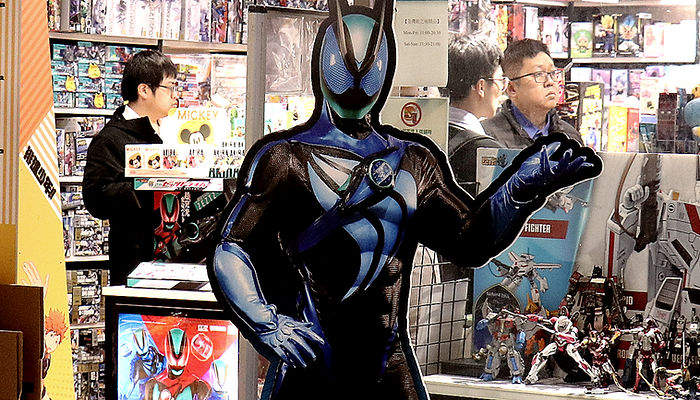
The latest Kamen Rider ZEZTZ is the 7th series in the Reiwa Era of the Kamen Rider franchise, premiering on September 7, 2025.
 |  |
|---|---|
 |  |
 |  |
Toy manufacturers such as Bandai have continued to release new henshin belts, the transformation devices used by Riders with each season.
Bandai Namco has continued to treat tokusatsu merchandise as a durable business line, with Kamen Rider transformation belts and related goods still generating strong sales across multiple seasons.
In its fact book for 2025, the company reported fiscal year 2025 worldwide sales of ¥30.7 billion (HK$1.51 billion) for the Kamen Rider series, ¥14.0 billion (HK$686 million) for Ultraman, and ¥6.4 billion (HK$314 million) for Super Sentai, while cumulative shipments of Kamen Rider transformation belts reached 17.41 million units by March 2025.
Bandai Namco’s 2025 financial report said adult-targeted collectibles were a key driver behind the company’s record-breaking growth, with group net sales reaching approximately 1.24 trillion yen (HK$60.76 billion)—an 18.2% increase compared with the previous fiscal year.
Asked whether toys are only for kids, Wong disagreed.
“People say toys are for kids," he said. "But I think I still have a kid inside me, even if I'm older now.” Wong sees no reason to stop. “I've liked it since I was a kid, doing quick mental math. Six years old till now… more than ten years already.”


Wong is showing the Kamen Rider Decade Henshin cards. These are the original cards, which he has protected and stored since childhood, and they are now safely kept in his cardbook.
As adult collectors become a growing force in the toy market, Wong's story mirrors a broader trend.
His connection is still personal, linking between his childhood dream and his creative goals today.
“I like what I like,” he said simply. “It's not something I'd regret. It's just part of my adult interest.”
Besides Bandai’s main products, figures and Ichiban Kuji lotteries have also become a popular, growing part of Hong Kong’s toy culture.
When warehouse worker Lam Chun-long, 25, walks into his small flat after work, the first thing he notices isn't the bed or the television—it's the shelf lined with well arranged anime figures.
Lam is a big anime fan who loves stories with complex plots and psychologically intense themes.
He is drawn to dark stories and characters with tricky morals, and he often finds inspiration and deeper insights from them.

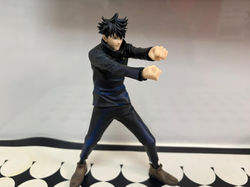
Lam holds his favorite character figure—Suguru Geto from Jujutsu Kaisen—which costs at least four digits on the market.

The Kotobukiya ARTFX J Levi series is widely considered one of the best figure lines for Attack on Titan fans. Scale: 1/8 (Approx. 280mm tall). Price ranges between HK$800 to HK$1,400.
Collecting figurines of his favorite characters has recently become one of his growing hobbies. Some figures he owns were won through Ichiban Kuji lotteries in Japan, others bought from local stores in Mong Kok.
For Lam, these aren't toys. They're symbols of the stories and philosophies that shaped the way he sees the world.
“I started collecting because of Jujutsu Kaisen,” Lam said. “I've watched a lot of anime, but this one is the most meaningful. It's not just fighting—it's about people trapped in a cycle, trying to find meaning in a world that repeats itself.”
Kotobukiya's ARTFX J series is a figure line built around popular Japanese anime and game properties, with a focus on highly detailed sculpting and character fidelity.
The brand describes it as a continuation of Kotobukiya's ARTFX sculpting tradition, aimed at bringing beloved Japanese characters to fans worldwide.
Among Jujutsu Kaisen's sprawling cast, Lam is drawn to the character Suguru Geto, a former hero who turns against the system he once protected.

Kotobukiya Japan’s ARTFX J — Suguru Geto (Jujutsu Kaisen: Shibuya arc)—1/8 scale model (from the Hidden Inventory & Premature Death ver.).


“This character reflects the reality of Hong Kong's poverty problem,” Lam said. “He wanted to help the weak, to make the world better. But later he realised that, no matter what, the weak would stay weak and the strong would dominate. He tried and started killing the weak, keeping only the strong.”

“I think I'm similar to those character I like,” he said. “When I was younger, I tried to think positively. But as you grow up in Hong Kong, you start to see how things really work.”
Lam didn't grow up in an environment filled with collectibles, viewing toys as unattainable luxuries during his childhood due to financial limitations and his parents' emphasis on necessities.
His interest in collecting emerged later, after he started earning his own income in his early twenties.
Lam expressed admiration not for Geto's downfall but for his honesty, noting that while Geto's actions were misguided, he acknowledged the harsh reality and faced it despite the personal cost.
Something Lam believes many people fail to do in real life and accept the situation of the poor get poorer and the rich get richer, those rich will never help those poor.

“Everything depends on money—your hobbies, your chances, your happiness. If you don't have money, you can't survive. That makes you see life the way Geto does—realistically,” Lam added

Lam’s first purchase was a Jujutsu Kaisen figure: Sukuna from the Combination Battle 2 statue. This PVC/ABS figure is battle-ready and stands over 4.5 inches tall.
“When I started working, I finally had the right to decide how to spend my money,” he said. “That freedom mattered. I didn't want to keep denying what I liked.”

Lam explains each of his figures while brushing away dust, as they’re displayed in his small room.
His first purchase was modest—a sitting figure of the Jujutsu Kaisen character Sukuna, bought for about HK$200 from Sino Centre in Mong Kok, a popular spot for anime goods.


Lam's favourite spot for buying figures and anime merch at Sino Centre—figures, plushies, keychains, posters, blind boxes, stationery, cosplay & more (Naruto, One Piece, Jujutsu Kaisen, Demon Slayer, AOT, MHA, Chainsaw Man, Spy x Family).
“I bought every figure simply because it was affordable and I liked the anime,” he said. “At first, it wasn't about collecting—it was just something that made me happy to have around.”


Inside Sino Centre, a cluster of stores sells a wide range of anime-related products—from manga, figures, and posters to cosplay accessories and soundtracks—at generally affordable prices, though some limited-edition or rare items are marked up significantly above market value.
That small purchase opened a new habit. Soon he discovered Ichiban Kuji, a Japanese lottery system where players pay for random anime merchandise.
“Ichiban Kuji is very addictive,” Lam admitted with a grin. “Sometimes you win small things like badges or acrylic stands, but once in a while you win the limited-edition figure, which is very costly.”
One of his expensive buys was a Mahoraga figure from Jujutsu Kaisen—acquired in Taiwan through a Kuji event for HK$2,400.
“I had to buy the full set from the Ichiban Kuji to get the one I wanted,” he said. “It was a lot of money for me. But that figure was beautiful, limited, and meaningful. I didn't want to lose the chance.”
Lam also bought a Suguru Geto scale statue for about HK$1,200 through an online seller on Taobao.
Though wary of replicas, he confirmed the manufacturer as Japanese.
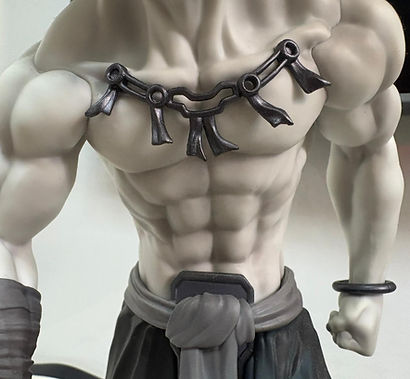

Ichiban Kuji’s Jujutsu Kaisen Shibuya Incident Arc Part 3 – Last One Award: Mahoraga Figure.
“Many figures are made by Japanese companies but sold through Chinese platforms,” he said. “That's normal now—from my observation, many Japanese brands have factories or distributors in China. It's a trend.”
Japanese figure and model-kit makers like Good Smile Company distribute their products into the Chinese market through official Chinese-language shops and partner retailers on platforms such as Taobao and Tmall.
A 2024 report from the China Toy and Juvenile Products Association (CTJPA) on Tmall's toy market found that figurine sales revenue in China rose 8.5% in the first half of the year, while sales volume increased 34.5%, showing strong demand growth even as prices and competition remain high.
 |  |  |
|---|---|---|
 |  |  |
 |  |  |
The same report said Good Smile—Japanese anime figure production—ranked first among the top 20 figurine brands with a 16.6% market share, underscoring the strength of Japanese-origin brands in China's online collectibles market.
This shows how Japanese brands increasingly rely on Chinese-market e-commerce channels to reach local consumers, even when the designs are developed in Japan.
Lam treats his collection as decoration rather than play.
“I don't move them around or unbox some of them,” he said. “I use them to decorate my room. When I see them, I feel calm. They make my home feel like my own space.”


Ichiban Kuji's Anime series of My Hero Academia: HERO VS VILLAINS — C Prize Figure of Shoto Todoroki.


Travesia.jp reports that Japan's collectors' toy market is being shaped by adult consumers who buy figures primarily for display and collection.
This approach fits with a growing trend among Asian collectors who like to display their toys. Adult buyers care more about precise sculpting, painting, and emotional appeal than whether the toys can be played with.


Buyers are paying more attention to precision sculpting and paint quality, pointing to a growing preference for display-oriented collectibles over toys designed for play.
Lam's connection with anime worlds goes beyond display shelves, it's etched onto his skin.

After being deeply moved by the anime's message of survival and pain, he first bought a figure of Guts, the series' lone warrior protagonist from Berserk.
“I bought it because I admired his strength,” Lam said. “He went through everything—betrayal, suffering, war—but still fought without giving up.”
For a while, that figure was enough to represent what the story meant to him. But gradually, Lam felt that looking at it could not capture the full depth of what he learned from Berserk.
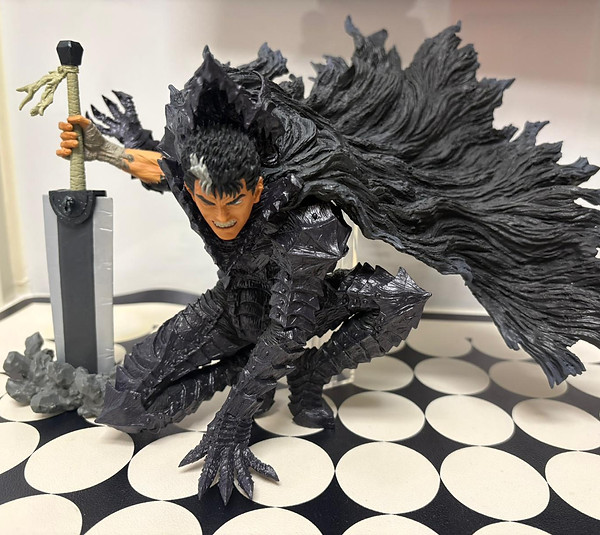
From the anime—Berserk—bought through Ichiban Kuji 'Oath of Counterattack,' Lam has the Guts figure in his collection.


“Collectible figures were beautiful, but they couldn't remind me of what I needed every day,” Lam said. “So I had the thought of putting meaningful things from the anime I loved on my skin. I wanted a mark I could carry to remind myself to keep moving forward, no matter what.”

Lam got the Brand of Sacrifice — the cursed mark from Kentaro Miura's dark fantasy manga Berserk, famously borne by the protagonist Guts — tattooed on his back, just below his neck.
On his back is the Brand of Sacrifice, a cursed mark from Berserk, a dark fantasy manga known for its brutal realism and psychological depth.
“That's mark means all misfortune follows you,” he said. “It attracts pain, ghosts, and bad luck." But to me it means: if you survive all that, you become stronger. What doesn't kill you makes you stronger. That's why I tattooed it.”
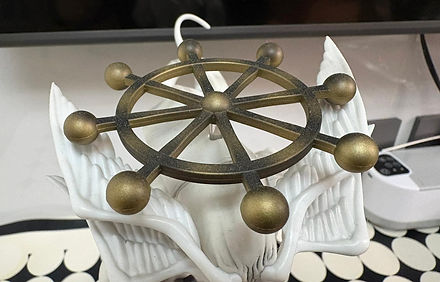
On his left arm, near his wrist, is a design inspired by the Jujutsu Kaisen creature Mahoraga, a divine shikigami known for adaptive abilities.
“It has a gear-shaped halo that turns every time it's hit,” Lam explained. “When it turns full circle, it adapts and can't be hurt by the same attack again. That's how I want to live—to keep adapting. If I can adapt, I will keep improving, just like Mahoraga's ability.”

Lam got a tattoo of an angel with wings on his left arm, representing the character Mahoraga, with eyes on the wings.

He described collecting as a way to recreate a sense of joy. Home is not only a place for rest but also a space that inspires return, where familiar possessions evoke comfort and personal attachment.
Lam admits figure collecting can be expensive.
“A lot of figures are overpriced,” he said.
Lam described his day job as monotonous and exhausting. His figures provide balance.
“Work is tiring,” he said. “In a city like Hong Kong, people come home and sleep. For me, I go home and look at my figures. They remind me I'm still living for something I like.”
“Scalpers raise prices when something becomes hot. It's both good and bad. A high price shows people value it, but it also shuts out fans. I only buy what I really want, what means something to me,” he added.
Lam’s latest figure purchase is also a character from JJK: the SEGA Luminasta 'Jujutsu Kaisen: Hidden Inventory / Premature Death' Toji Fushiguro — as he wants to achieve the same muscular physique as this character.

For Lam, the motivation lies not in social status but in personal fulfillment.
He emphasizes that his purchases are driven by genuine interest rather than a desire to impress others, choosing items he appreciates even if they are not widely understood.

For Lam, purchasing figures in adulthood is not an act of childishness but a way of emotional restoration.
He sees it as an opportunity for adults to reclaim the unfulfilled desires of their childhood, filling a sense of emptiness left from those earlier years.


Lam’s eyes brightened when asked about future plans.
“I don't want hundreds,” he said. “I just want meaningful pieces, ones that tell me something. Maybe the world is harsh and unfair, but when I look at my collection, I remember I can still choose what makes me happy.”
Some collectors continue their habits into adulthood, often driven by interests they developed in childhood.
Growing up with parents in international trade, Cheng Chi-hei, 24, spent her early years shuttling between airports and hotel rooms worldwide.
To the outside world, her life looked glamorous—business-class seats and five-star hotels—but it often left her alone for hours, waiting for her parents to return from meetings.
“In my kid period, I was often alone in hotel rooms, with the curtains half open and sunlight slanting in,” she said.
“I would count the sound of planes taking off and imagine how people outside were living their lives,” she added. “What I missed most was that moment when the door handle turned, the sound of my parents finally coming back.”
Everything changed when Cheng went on a business trip to Bangkok.

Cheng loves her newest doll, Shima-enaga, a famous bird from Hokkaido, Japan, which she got during her ski trip in December 2025.

Cheng's very first teddy bear doll was bought by her mother when she was seven years old in Bangkok.
Feeling bored in her cold hotel room, she doesn't remember why she kept drawing teddy bears on that trip. But her mother saw her drawings and took her shopping the next day.
 |  |  |
|---|---|---|
 |  |  |
 |  |  |
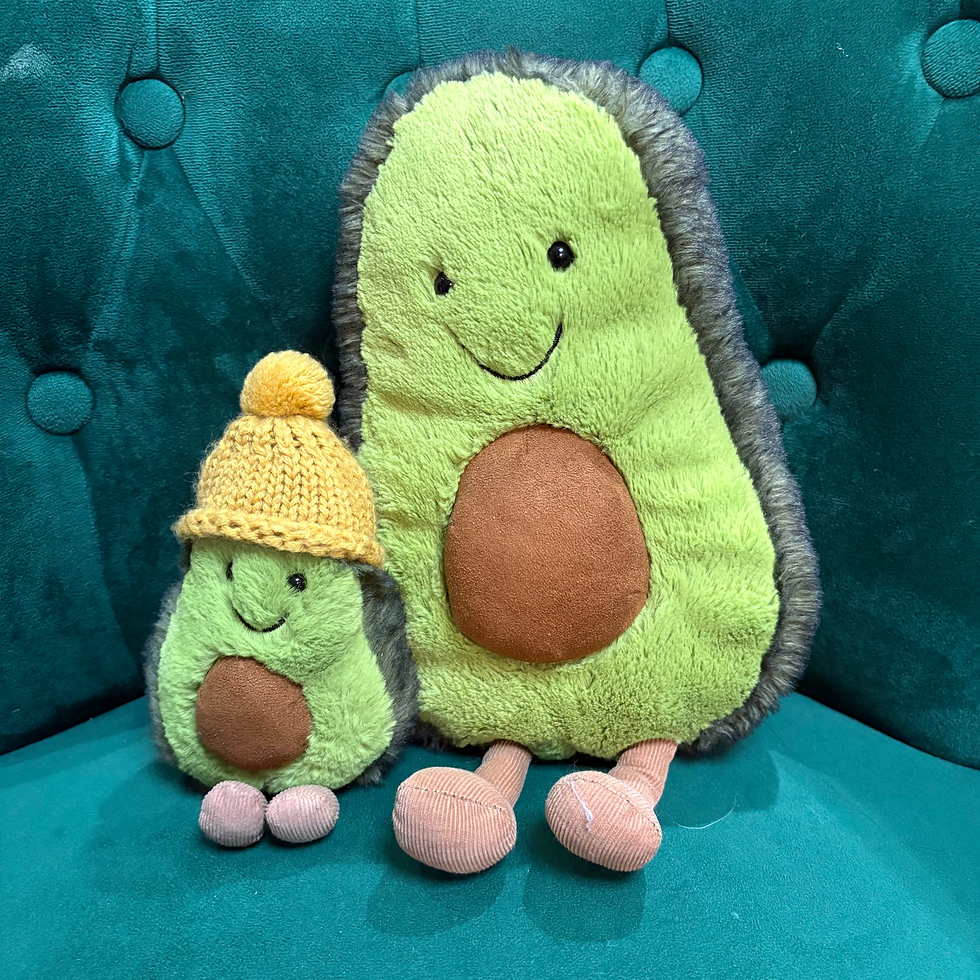
Her mother bought Cheng her first plush bear as a keepsake for Bangkok and said it would protect her when they were away. From then on, the rule was: one place, one soft toy. She never packed them all for trips; each stayed home as a reminder of that place, while she kept buying new ones.
Cheng explained her "one place, one soft toy" philosophy keeps the memories pure and portable in spirit, if not in luggage. She buys on every trip but leaves each new doll behind in Hong Kong, never mixing them on the road.
“I don't carry every doll together—that would be chaos,” she said. “It's one per place. I keep buying, but each one stays home after the trip.”

Cheng's JellyCat grey bunny was bought during her trip to Paris.
In 2024, global revenue for Jellycat surged to £333 million (about HK$3.2 billion), up roughly 66% year-on-year, driven largely by young-adult consumers who treat the plush as emotional companions and collectibles rather than just toys.
In Hong Kong specifically, demand has become so intense that key seasonal Jellycat lines are regularly sold out almost as soon as they arrive.
“That bear is forever Bangkok; that JellyCat bunny is forever Paris. They don't travel with me—they wait, marking exactly where I've been,” Cheng added.
Jellycat plush soft toys, once seen as simple children's comfort toys, have become a must-have adult accessory in Hong Kong, with fans snapping up limited editions in Central, Tsim Sha Tsui, and online boutiques.




According to Statista, visitors to Jellycat’s website are aged 18 to 34, reflecting an adult-dominated buyer base despite soft toys historically being aimed at young children.
BabyPark in Kowloon Bay and JakeWell in North Point report Jellycat's "Bashful Beige Bunny" leads sales across sizes.
Prices vary by size and seller: Small (≈18 cm) HK$160 to HK$225; Medium (≈31 cm) HK$295 to HK$338 (up to HK$580 at luxury florists); Huge (≈51 cm) HK$815; Really Big (≈67 cm) HK$1,228 to HK$1,365; Really Really Big (≈108 cm) HK$2,038 to HK$2,265.
Cheng added its design, softness, and quality drive demand, while price differences reflect retailer positioning and promotions, but Jellycat seldom has discounts.

Two huge bunnies from Cheng’s collection were bought on two separate trips to the UK.
Cheng's home holds the full archive: one soft toy per destination, accumulating over years without overlap.

Some of Cheng's soft toys still don’t have a place to be displayed, so she uses a luggage bag to store them.

Cheng now enjoys searching for dolls in colors she likes. For example, she wants a light grey soft toy that she doesn’t have yet.
“Some of the fabric is covered in lint, and some of the colors have nearly faded,” she said. “I'll keep them all and store them in my soft-toy luggage.”
“But as soon as I see each one, I remember the weather that day and exactly how I felt—happy, lost, or somewhere in between. One doll, one raw memory from one place. I just keep adding to the collection, trip by trip.”
“When I travel, I arrive, explore, buy one soft toy, and fly home with just that memory in tow.”
The Hong Kong toy market is one of the more mature and import-driven toy hubs in Asia, with soft toys forming a leading product category.
 |  |  |
|---|---|---|
 |  |  |
In 2025 the market grew again after earlier pandemic-affected years and is projected to expand at a compound annual growth rate of about 7% to 7.25% from 2026 to 2032, fuelled by rising disposable income, e-commerce, and demand for premium and licensed toys, according to market-research firm 6Wresearch and the IndexBox Hong Kong Toys Report.

According to market-research firm 6Wresearch, soft toys are the leading toy type in Hong Kong by demand, driven by a broad customer base of young children plus strong interest in character-based and interactive soft toys (for example, brands like Barbie and other licensed IPs).
Hong Kong remains heavily import-dependent: in 2024 to 2025, China supplied about 76% of soft toys and toys imported into Hong Kong by value, with Japan a distant second around 12%.
This reflects Hong Kong's role as a distribution hub rather than a mass-production base, since local toy production in value terms has declined sharply over the last decade and now sits at relatively low levels.


Beyond children's soft toys, Hong Kong has a strong and growing collectible-soft-toy and collectible-toy market, often driven by so-called kidults (adults who collect toys).
A 2025 Carousell survey of Hong Kong users found that Hobbies and Toys was the most-traded category on the platform in 2024, accounting for nearly 45% of regional transactions, with many of those items being second-hand soft toys.
In that same survey, the majority of collectors were aged 31 and above (58%), with the 50 and above group alone making up 23% of respondents. About 51% of those collectors said they had been collecting for over five years, indicating a long-term, committed base.
Now, Cheng absolutely adores her room overflowing with soft toys—those three glass cabinets form her personal museum of memories and comfort.

She keeps buying the ones she loves, bringing each new treasure back to join her ever-growing soft toy family.
What began as a way to combat childhood loneliness has blossomed into a true passion, her deepest interest and source of joy.
“Even as an adult at 26, I still love sleeping with them piled around me, playing with their little poses and outfits, and hunting down the cutest new ones wherever I go,” Cheng said.
Cheng is also a Japan travel lover, so she's fallen for recent Japanese IP trends. When the recent Chiikawa trend hit, she started collecting her favorite character from the anime, Momonga—a naughty flying squirrel.

Cheng is holding a cat-shaped doll that she thinks looks ugly, but she loves it. It's part of the recent trend of "Ugly-Cute" dolls.

Momonga is a small, squirrel-like character (a flying squirrel) from the popular Japanese manga and anime series Chiikawa, known for its cute, slice-of-life stories and wide popularity on social media.
“I love how he's often seen seeking attention and praise, stealing food, and causing trouble for other characters—such antics attract my rebellious heart,” Cheng added.
According to AllRightsReserved (ARR), the Chiikawa Days exhibition at K11 Musea drew more than 100,000 visitors, about 70% of them local residents, and contributed to a roughly 30% year-on-year rise in August 2025 spending at the mall, with fans regularly spending hundreds of Hong Kong dollars per visit on Chiikawa soft toys and other products.
According to Chiikawa, the main cast has been rolled out into a wide range of soft-toy-style products, including plush soft toys, keychain pendants, and small vinyl figures.


The most commonly seen character soft toys in official merchandise lines are:

Chiikawa’s popularity in Hong Kong surged starting last year, according to Google search trend data (a value of 100 represents peak interest within the selected region and time frame).
According to Google trend, interest in the Japanese manga character Chiikawa climbed sharply in Hong Kong from 2024 onward, hitting an all-time high of 100 in August 2025 amid pop-up store mania and merchandise hype.
Since then, search volumes have dropped steadily, settling by 2026 at levels typical for a mature brand.
Chiikawa: A round, white, mouse-like character available as plush (including 13 cm pendants), hanging toys, crawling figures, and mini vinyls.
Usagi: A split-face rabbit featured in hanging plush, Star Wish keychains, Smirks mini plush, and desktop hook plush.
Neko-chan: A pink-cheeked cat featured in branded plush and mini series, known for its doll-like face and pastel colors.
Rakko: An otter featured in food-themed hanging plush and small plush or keychain formats.
Shisa: A lion-dog featured in hooked “desktop guardian” plush (e.g., holding ramen) and limited-run series.

Two Wonderland Superstore staff count the day’s newly arrived dolls. (Whampoa Store)

“With Chiikawa's rising popularity, customers have been flocking in—especially for the soft toys,” said a Wonderland Superstore staff member.
“Most buyers are teens and young adults, roughly 15 to 30 years old. When an IP is hot, demand can outstrip supply, but now that the hype is cooling we're seeing sales level off.”
“That's normal—it happens with other brands too. Once the buzz dies down, like it did with some Sanrio soft toys, far fewer people buy them,” the staff from Wonderland Superstore added.

Wonderland Superstore’s doll shelves are packed with a variety of IP dolls — available at multiple discount offer, among 50% to 20% off.

Cheng has recently started building a Sanrio Pompom Purin collection, drawn to the character’s yellow “pudding dog” look—since Cheng especially loves the color yellow.
Sanrio's FY2026 financials report Asia net sales at 18.6 billion yen (HK$916.5 million, up 60.6% year-on-year), including Hong Kong/Macau licensing growth in toys, apparel, and accessories driven by Kuromi, Hangyodon, and corporate collabs.
“Pom Pom Purin is the most charming of all the Sanrio characters. Many people choose their favorites based on colors, animals, or vibes, others might go for Melody, Hello Kitty, or Kuromi,” Cheng added. “But since I love the color yellow and adore dogs, it's only natural that I fell in love with this pudding-like golden dog.”


“For me, soft toys are not just toys anymore—they’re my family, my happy place. I’ll never stop adding to this collection; it’s what makes me feel whole and joyful,” Cheng said.
Sanrio soft toys emerged from the company's origins in 1960, founded by Shintaro Tsuji as Yamanashi Silk Company in Japan.
Key Characters: Hello Kitty, Cinnamoroll, Pompompurin, Kuromi, My Melody, Pochacco, Little Twin Stars, Bad Badtz-Maru, Kerokerokeroppi, Tuxedosam, Hangyodon, Gudetama.

Sanrio's Character Grand Prix (latest 2025 results) shows dogs dominating top spots—Pompompurin (#1, golden retriever), Cinnamoroll (#2, white puppy), Pochacco (#3)—with over 63 million votes from 90 characters, suggesting possible animal appeal (dogs over rabbits/cats).
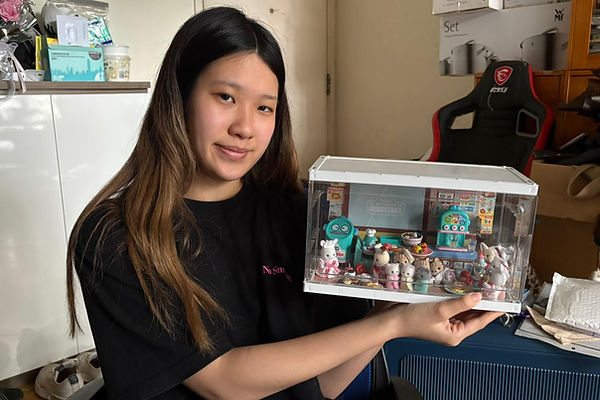
Tam showcases her beloved Sylvanian Families collection, beautifully handcrafted and thoughtfully arranged in her custom display box.
Charlotte Tam Cheuk-wing, a 22-year-old online vintage clothes shop owner in Whampoa, has spent years collecting Sylvanian Families toys. It's not just a hobby for her.

It's an important escape from the stresses of adult life.
For her, these tiny creatures help her keep her happiest memories alive and reconnect with who she was before city life took over.
Tam dedicates her days searching for unique clothing pieces, both online and at local markets.
Reselling these curated garments is her only source of income, but it demands a high level of self-discipline. The work can often feel dull, with its repetitive tasks and the necessity for constant availability, as she serves as both the owner and the sole employee of her small business.

She loves buying, collecting, and displaying Sylvanian Families, especially the cute and tiny rabbit dolls.
This passion not only brings her joy but also motivates her to earn money.
The delightful charm of these miniature animals adds a special happiness to her life.
Sylvanian Families is a toy line from Japanese company Epoch, first launched on 20 March 1985.
The company introduced small animal figures, houses and furniture as a system that let buyers build stories in a single compact world.
Brand histories and company material indicate that by the mid-2000s total global sales had passed tens of millions of figures.
In 2025, Sylvanian Families celebrated its 40th anniversary, put the lifetime figure sold at more than 100 million units in over 50 countries.

Sylvanian Families, started in 1985, includes cute animal figures and detailed mini sets, and became very popular in Hong Kong in the 1990s.
Design and brand control stay in Japan while most manufacturing is in China and other Asian countries under Epoch's quality and safety standards.
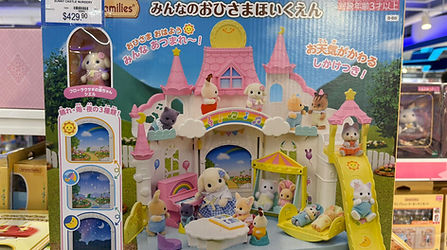
The official Hong Kong product catalogue (in Chinese) shows that the line is built around animal families, houses, furniture and accessories grouped into sets that combine with each other.
Most Sylvanian Families figures are around six to eight centimetres tall, putting them in what collectors describe as approximately 1/18 to 1/24 scale relative to human size.
Due to Hong Kong housing size, this places Sylvanian Families in the collectible playset segment of the toy industry, competing with other figure-and-playset ranges for shelf space and spending.
A typical adult-animal figure sold by a European retailer is listed at about 8.4 cm wide, 5.6 cm deep and 5.2 cm high, or roughly eight by six by five centimetres.
 |  |  |
|---|---|---|
 |  |  |
 |  |  |
 |  |  |
In Hong Kong, Sylvanian Families is part of the regular toy offer in chain outlets as well as online platforms.
The line is widely available at Toys"R"Us branches and at Wonderland Superstore, where shelves carry family sets, buildings and smaller add-on items, usually cost from HK$100 to HK$500.
Department store counters and online shops, including an official flagship store on HKTVmall, also sell the range and handle new releases and promotions, costing from HK$40 to HK$1100.
Her connection to the brand began in the most innocent of ways.
“When I was a little girl, I loved going to the toy shop after school,” Tam said.
“It was a small shop with pink flags at the door and a big glass window full of Sylvanian Families toys. I always stopped to look.” Tam added. “The tiny rabbits, squirrels, and bears looked so warm and happy. Their little homes were clean and quiet — a perfect world that I wished I could live in.”

Tam's favorite is the Hangyodon theme set, which she creatively combined with her chosen Sylvanian Families.

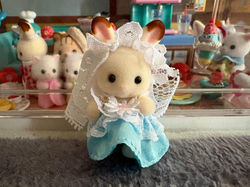
Tam recalls picking up this luxurious pink rabbit from the Sylvanian Families line, a childhood favorite she always wanted. However, now that she's grown up, her taste has changed, and she’s no longer drawn to pink like she once was, so she wouldn't buy it today.
Tam explained that Sylvanian Families toys usually come in themed sets. They create a world with different rules—one of afternoon tea parties, gentle walks, and cozy fireplaces. This is a big contrast to the chaotic energy of the city outside her window.
Tam once carefully arranged miniature furniture and took great care in displaying her Sylvanian Families toys. However, as she entered secondary school, growing academic demands and exam pressure gradually took over her time for play. The dolls were eventually packed away, replaced by piles of homework and study materials.
“When I grew older, schoolwork got heavy, and I stopped playing. My toys were packed away in boxes. I thought, I should grow up now.” Tam said.
This message—"I need to grow up now"—is something many people hear in a high-pressure city that values hard work and practicality.


When Tam was 20, “One day, when I cleaned my room, I found that old box again. The smell of the plastic and old paper brought back so many memories. I picked up the tiny bunnies and remembered the pure feeling of joy. It reminded me of my childhood — once I wanted to collect a lot of them in my room.” Tam added.
In that moment, the bunnies weren't just toys—they were a direct connection to the version of herself she had been told to leave behind.

One part of Tam's Sylvanian Families collection is organized by the order in which she bought them. Each piece represents a special memory and shows her love for these adorable toys.
“They remind me of my childhood dreams. Back then, school pressures made me abandon my passion for collecting what I loved. But now, I can finally choose to follow my heart.” she said.
It was no longer just about playing like a child; it was about creating a feeling.
Cleaning the tiny furniture and carefully placing each figure helped her relax, and she even started customizing tiny decorations for her collection.
“Sometimes people ask why I still buy toys as an adult. I just smile and say that collecting brings me joy, and that's all that matters. I'll keep them forever.” she added.
The question, often laced with judgment, doesn't faze her. She understands that to an outsider, a 22-year-old woman collecting toys might seem like a refusal to grow up.
But for Tam, it's different. She makes a choice to keep her true self while dealing with the demands of adult life.

Tam's handmade decorations were connected to her Hangyodon x Sylvanian Families set.

Tam's one-of-a-kind collection of Sylvanian Families is carefully stored in a plastic box to keep them in perfect condition and protect them from dampness.
In online collector communities, Japan is often described as a central hub: a 2026 buying guide based on a survey of 2,841 collectors identifies Japanese releases and region-exclusive sets as some of the most sought-after items, especially limited-edition houses and numbered collector's edition runs.
Her collection has also grown up, evolving from the standard sets to a hunt for the extraordinary.
Her collection has also grown up, evolving from the standard sets to a hunt for the extraordinary.
“Now I tend to buy limited editions or special types of Sylvanian Families characters straight from Japan,” she said. “Collecting Sylvanian Families makes me love Japan and when I have time, I must choose to go Japan for travel trip while relax myself out of the stress of HK.”
Collectors in Japan frequently track new drops through official Epoch and Sylvanian Families social accounts, participate in lottery draws and in-store events, and swap or resell older figures via second-hand and auction sites, which points to a dense, active local market that shapes how the brand is collected elsewhere.
Carousell Hong Kong, one of the city's most popular second-hand marketplaces, currently lists over 7,000 Sylvanian Families items. Offerings range from single figures to complete sets and even custom boxed collections created by individual sellers.


“Buy and search for the toy and collection I love, searching them in Japan one by one and bring them back to my home add into my collection, the feeling feels so good,” Tam said
 WhatsApp Image 2026-03-07 at 02.50.11 (1) |
|---|
 WhatsApp Image 2026-03-07 at 02.50.10 |
 WhatsApp Image 2026-03-07 at 02.50.10 (1) |
 WhatsApp Image 2026-03-07 at 02.50.10 (2) |
 WhatsApp Image 2026-03-07 at 02.50.09 |
 WhatsApp Image 2026-03-07 at 02.50.09 (2) |
 WhatsApp Image 2026-03-07 at 02.50.09 (1) |
 WhatsApp Image 2026-03-07 at 02.50.08 (1) |
 WhatsApp Image 2026-03-07 at 02.50.08 |
 WhatsApp Image 2026-03-07 at 02.50.09 |
The stress of Hong Kong's busy life fades away when she visits Japanese toy stores, where she carefully chooses the perfect, rare bunny doll to bring home.
Each piece isn't just a purchase; it's a trophy from a journey, making it more meaningful.
“Collecting Sylvanian Families isn't just about toys, it's about preserving my happiest memories and reclaiming the missing pieces of my childhood, including my interests and regrets,” she added.

She said she likes how the toys suit Hong Kong, because the figures are small, the houses are not too space-consuming, and the prices are still reasonable compared with many other toys.

Collecting Sylvanian Families is much bigger in Japan than in Hong Kong.
In Japan, collectors can turn it into something almost like a subculture on Instagram, while in Hong Kong she has found only a few people who are really into it.
One university friend even makes clothes for Sylvanian Families and Chiikawa figures, which she described as a very impressive and creative way to play.


Another Sylvanian Families collector, Wong Yee-man, 32, often takes her Sylvanian Families figures out for photo outings.
“I take them out for photos a lot, to the beach, to Discovery Bay, even to Mount Fuji when I travel,”Wong said.


Her collection has grown to nearly 300 figures, many of them gifts from friends and family.

The Google document Wong created to record the name, type of name, identity, date of buying, and picture of each figure into a list.
“I even made a family tree for all of them and saved it in Google Drive,” she added. “Each one has its own name, and I've already named 61 of them.”

Her first Sylvanian Families figure was a male Persian cat, which was a gift from others, and many of her figures came from people around her after they learned she was collecting.


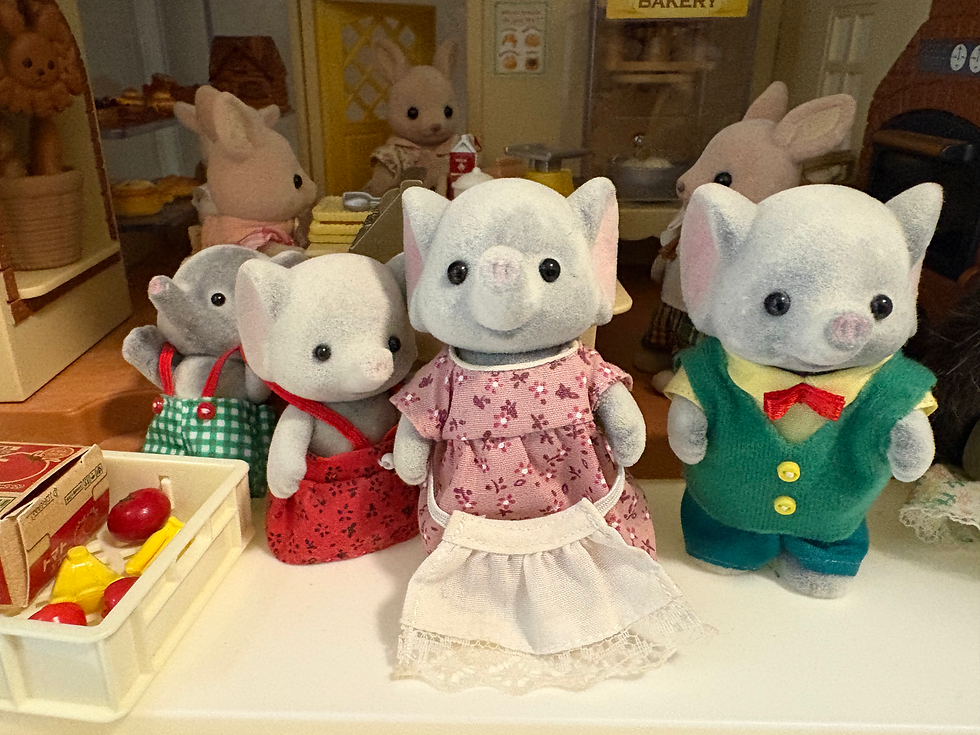


“What began as simple gifts from friends and family slowly grew into something more, piece by piece,” Wong said. “I built a world around them, carefully curating each one. What started as keeping memories has become a passion that has stayed with me since my university days.”


Sylvanian Families furniture, house, and vehicles chosen to match different theme of sets, to display alongside her collection.
Wong estimated her collection could be worth over HK$20,000, especially once houses, cars, and vintage items are included.
Some rare or discontinued pieces were harder to find in Hong Kong, so she had to look in Taiwan and use a local buyer to send them back.
The year of 2018 was her biggest buying year, when she first got into the hobby and received lots of figures as gifts, and she estimated she may have spent about HK$4,000 to HK$5,000 that year alone.


“Sylvanian Families haven't really become a big target for resellers. Even rare old houses don't sell for crazy high prices like Lego, so the hobby still feels affordable and easy to enjoy,” Wong said.
A Psychologist Weighs in Toy Collecting


With the cases of toy collectors mentioned above, each individual comes from a different background and has their own reasons for continuing to collect toys. Lawrence Ma Ka-yin, chairman of the Organizing Committee of the Hong Kong Psychological Society (HKPS), suggests that they share a common underlying factor: anhedonia, which may drive their collecting behavior.
According to Ma, Anhedonia refers to a diminished ability to experience pleasure or satisfaction from activities that are typically enjoyable.
Ma said adult toy collecting is driven by dopaminergic reinforcement and anticipatory reward, where purchasing and unboxing create pleasure that reinforces repetition. Many collectors also rely on emotion-focused coping and compensatory consumption to manage stress.
Strong attachment often reflects deprivation compensation and symbolic self-completion, fulfilling unmet childhood desires and shaping identity. Spending is linked to hedonic consumption and escapism, though some develop self-regulation and resolve cognitive dissonance over time.
Emotional decision-making is influenced by the affect heuristic, loss aversion, and the endowment effect, while preferences for physical items show tangibility preference and align with object attachment theory and emotional memory encoding. Life events may trigger mortality salience and future-oriented cognition.
Market trends are shaped by the bandwagon effect, celebrity endorsement, and the scarcity principle, with blind boxes leveraging variable reward schedules. Consumer behavior also reflects hedonic adaptation, short-term gratification bias, and bounded rationality, while creators are driven by intrinsic motivation, self-actualization, and grit.
Ma added that collectors often exhibit nostalgia-based identity formation, using items for self-continuity and as symbolic meaning anchors tied to personal memories. This is reinforced by affective memory encoding, symbolic embodiment, deferred gratification, and symbolic longing.
Collecting can also provide vicarious mastery and imaginary agency, while practices like documenting or displaying items reflect symbolic self-extension, creative self-expression, and an identity-affirming subculture. Habits such as linking items to places show symbolic place-memory anchoring, often rooted in emotional attachment seeking and the use of comfort objects.

“Toy collector cases reflected that their collecting behavior is not about refusing adulthood, but about protecting the self,” Ma said. “These objects they owned serve as emotional anchors and extended‑self symbols, they store nostalgia, help regulate stress, and allow adults to reclaim joy without losing their identity to the pressures of the world.”